


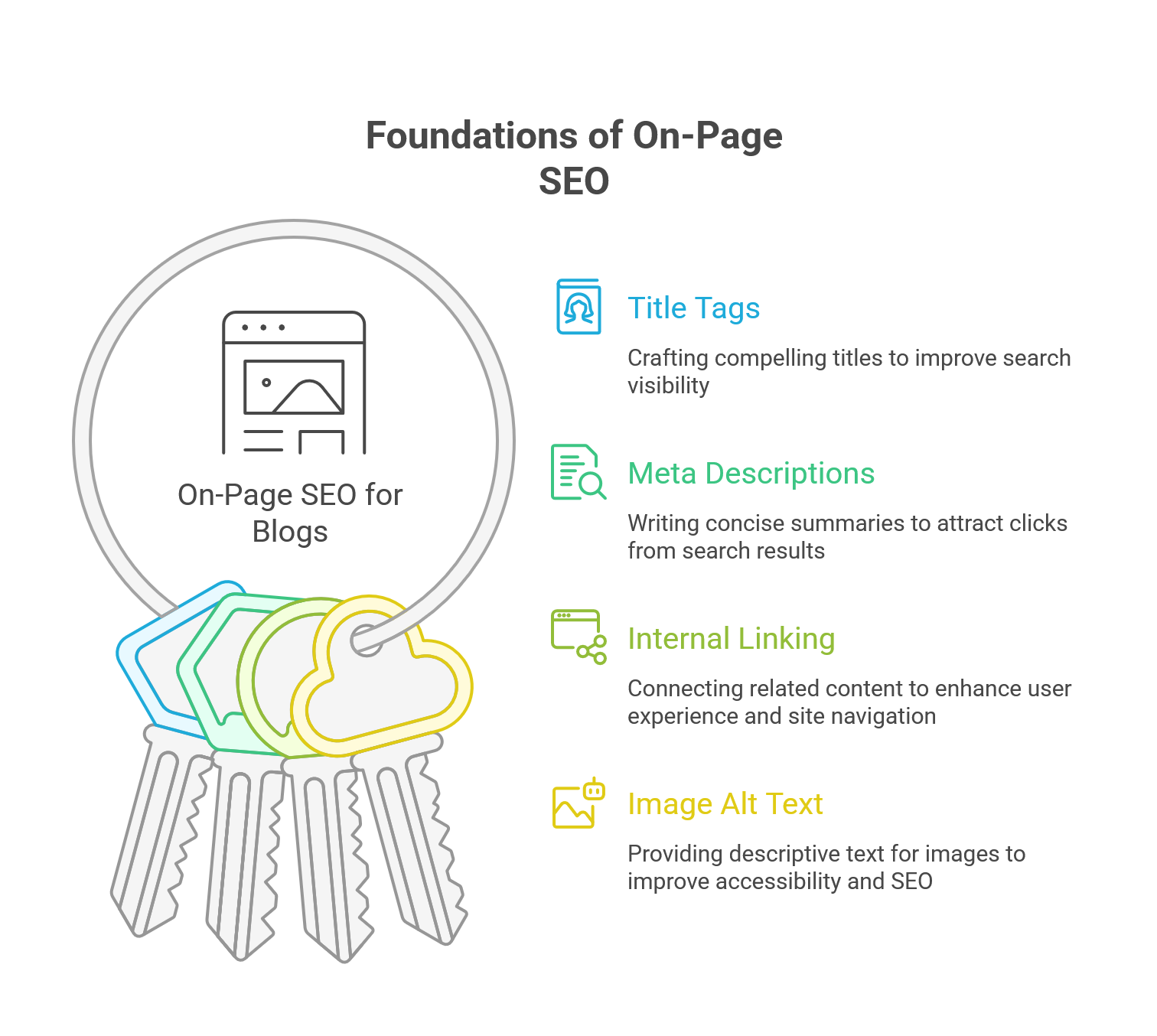
Share


 Copied
15 On‑Page SEO Tips That Actually Boost Blog Rankings
02 August, 2025

Carlos Dusan
Table of Content
- Match Search Intent Before You Write
- Choose One Primary Keyword and Cluster Support Terms
- Front‑Load Your Keyword in H1 and Title Tag
- Write Click‑Ready Meta Descriptions
- Keep URLs Short, Descriptive, and Keyword‑Smart
- Nail Your Header Hierarchy For Scannability
- Optimize the First 150 Words
- Use a Clean, Human Internal Linking Strategy
- Link Out to Reputable Sources
- Optimize Images For Speed and Search
- Earn Featured Snippets With Answer Blocks
- Implement Schema Markup When It Fits
- Improve Page Experience and Core Web Vitals
- Make Everything Mobile‑First and Readable
- Write for People First, Then Optimize
- Bonus: URL Hygiene and Indexing Basics
- On‑Page SEO Tips You Can Use Today
- Quick Reference Table: On‑Page SEO for Blogs
- Wrap‑Up: Ship smarter posts with on‑page SEO that moves the needle
Subscribe to Our Newsletter
Get the latest web development tips, SEO strategies, and industry insights delivered to your inbox.You are now subscribed to our newsletter. Thank you
Want your posts to climb the SERP and stay there? Use these on-page SEO tips to make every blog article easier to find, faster to load, and harder to ignore. You’ll see practical examples, checklists, and a simple internal linking strategy built for new blogs.
Key phrases sprinkled naturally throughout: on-page SEO tips, on-page SEO for blogs, internal linking strategy, best internal linking strategy for new blogs.
Match Search Intent Before You Write
If your content satisfies what searchers want, rankings follow. Study the top 10 results for your primary keyword and note content type, angle, and depth. Align your format accordingly: how‑to guides for informational queries, comparisons for commercial intent, and product pages for transactional topics.
Quick scan checklist:
- What format dominates the SERP
- How deep the pages go
- Which subtopics repeat
- What snippet types appear
Example: If “on-page SEO for blogs” shows comprehensive guides with examples, write a guide with examples not a thin list.
Choose One Primary Keyword and Cluster Support Terms
Pick one primary keyword with realistic difficulty and solid volume. Build topical relevance with semantically related terms and entities in sections and subheads.
Helpful sources for clusters:
- People Also Ask and Related Searches
- Competitor subheads and FAQs
- Tools like Keyword Magic and Writing Assistants
Front‑Load Your Keyword in H1 and Title Tag
Searchers skim first. Lead with the primary phrase in your HTML title and H1. Keep titles under ~60 characters to avoid truncation and include natural modifiers like “tips” or “2025” to boost CTR.
Good: “On‑Page SEO Tips for Blogs: 15 Proven Wins”
Better: “15 On‑Page SEO Tips That Actually Boost Blog Rankings”
Write Click‑Ready Meta Descriptions
Meta descriptions don’t directly rank but they lift CTR, which lifts traffic. Use 120–155 characters, include the main keyword once, state the benefit, and add a soft CTA like “see examples”.
Template: “Learn 15 on‑page SEO tips to improve rankings and clicks. See examples and quick wins inside.”
Keep URLs Short, Descriptive, and Keyword‑Smart
Short, readable slugs correlate with stronger performance and better UX. Use hyphens, include the core term once, and avoid dates. Redirect if you must change a slug.
Good: /on-page-seo-tips
Not great: /2025/08/02/15-on-page-seo-tips-that-boost-rankings
Nail Your Header Hierarchy For Scannability
Clear H2s and H3s help both readers and crawlers digest your content. Use one H1, then logical H2s and H3s with relevant keyword variations. Don’t stuff. Do preview the section promise in each subhead.
Mini pattern:
- H2: On-Page SEO Tip
- H3: Why it matters
- H3: Do this
- H3: Example
Optimize the First 150 Words
Signal relevance fast. In your opening paragraph, name the audience, surface the problem, add your primary keyword naturally, and promise outcomes. Pages that set expectations early retain more readers and earn more clicks from snippets.
Use a Clean, Human Internal Linking Strategy
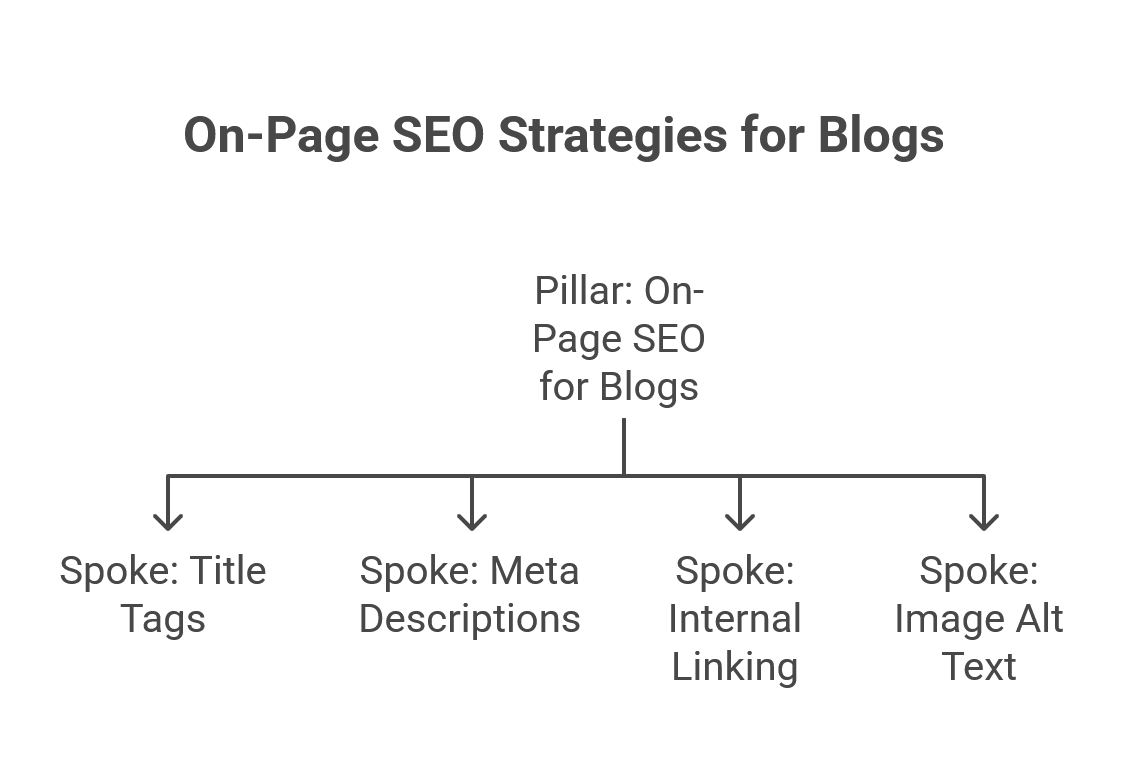
Internal links distribute PageRank, clarify context, and move readers deeper into your funnel. For new blogs, the best internal linking strategy uses a hub‑and‑spoke model.
- Pillar page (hub): “On‑Page SEO for Blogs: Complete Guide”
- Supporting posts (spokes): “Meta Description Tips,” “Image Alt Text Best Practices,” “Schema for Articles”
- Link each spoke back to the pillar with descriptive anchors like “on‑page SEO for blogs guide” not “click here”
- Crosslink spokes when topics overlap
Targets per post:
- Add 2–5 contextual internal links in new articles
- Update 2–3 older posts to link to the new one
- Use descriptive, keyword‑relevant anchors
Anchor examples:
- “on‑page SEO checklist”
- “internal linking strategy for new blogs”
- “image alt text guide”
Link Out to Reputable Sources
Outbound links support claims and help search engines infer context. Cite standards, primary research, and canonical definitions. Use sparingly and only where value increases.
Examples to cite in SEO articles:
- Checklists and frameworks from trusted SEO resources
- Platform documentation when applicable
Optimize Images For Speed and Search
Images can win traffic and wreck speed. Compress, resize, and rename files descriptively. Write concise alt text that explains the image’s purpose in context. Place visuals near related paragraph.
- File name: on-page-seo-internal-linking-diagram.png
- Alt text: “Diagram of pillar page with spokes for an internal linking strategy”
Simple diagram idea:
Earn Featured Snippets With Answer Blocks
Grab position zero with neat, direct answers. Use H2/H3 that mirrors the question and answer in 40–60 words, then expand with steps or examples. For “how to” add a short ordered list. For “what is” lead with the definition then add context.
Snippet template:
- H3: What is on‑page SEO for blogs
- Paragraph: “On‑page SEO for blogs is the process of optimizing titles, headers, URLs, copy, images, and internal links so posts rank higher and earn more clicks.”
Implement Schema Markup When It Fits
Structured data helps Google understand your content and can unlock rich results. For blog posts, consider Article, FAQ, HowTo, and Breadcrumb schema. Validate markup before shipping.
- When to use FAQ schema:
- Your post already contains short Q&As that benefit readers
- You can answer clearly in one or two sentences
Improve Page Experience and Core Web Vitals
Speed and stability shape engagement. Tackle Largest Contentful Paint (LCP), Interaction to Next Paint (INP), and Cumulative Layout Shift (CLS). Compress media, lazy‑load below‑the‑fold images, preconnect critical origins, and defer non‑critical JS.
Quick wins:
- Resize oversized hero images
- Serve next‑gen formats where possible
- Remove unused scripts and CSS
Make Everything Mobile‑First and Readable
Most searches happen on mobile and Google evaluates primarily the mobile version. Use responsive design, clean typography, short paragraphs, and generous white space. Break walls of text with lists, pull quotes, and visuals.
Micro‑formatting to boost readability:
- Sentences under 20 words whenever possible
- 2–4 sentence paragraphs
- Descriptive subheads every 150–250 words
Write for People First, Then Optimize
Helpful, expert content beats keyword stuffing every day. Demonstrate experience with examples, screenshots, and fresh data. Update aging posts regularly. Avoid thin rewrites and duplicate angles.
A practical cadence:
- Ship the post now with best‑effort optimization
- Add FAQs and examples in week two
- Refresh stats and links quarterly
Bonus: URL Hygiene and Indexing Basics
- Set one clean permalink per post and redirect old slugs
- Submit sitemaps and keep index bloat low
- Noindex thin tag pages or archives that add no value
On‑Page SEO Tips You Can Use Today
To turn these on-page optimization tips into momentum, run a simple 60‑minute upgrade sprint on one existing article.
- 0–15 minutes: Rewrite title and meta description with your primary keyword near the start and a benefit promise
- 15–30 minutes: Add two internal links in and two from related posts using descriptive anchors aligned to your internal linking strategy
- 30–45 minutes: Compress oversized images, add or fix alt text, and move visuals next to relevant paragraphs
- 45–60 minutes: Add one answer block targeting a featured snippet, then include a short FAQ with two precise Q&As
Track results in Google Search Console. Watch for changes in impressions, average position, and CTR over the next two weeks.
Quick Reference Table: On‑Page SEO for Blogs
| Area | What to do | Why it matters |
| Intent | Match SERP format and angle | Improves relevance and engagement |
| Keywords | One primary + related entities | Builds topical authority |
| Titles/H1 | Front‑load the keyword, keep under ~60 chars | Higher relevance and CTR |
| Meta | 120–155 chars with benefit and CTA | Lifts CTR |
| URLs | Short, hyphenated, descriptive | Better UX and crawl clarity |
| Headers | Logical H2/H3 hierarchy | Scannability and context |
| Intro | Keyword and promise in first 150 words | Early relevance signal |
| Internal links | 2–5 contextual links with descriptive anchors | Passes authority and guides readers |
| Outbound | Cite reputable sources sparingly | Adds credibility |
| Images | Compress, rename, add alt text | Speed and accessibility |
| Snippets | Answer blocks and lists | Position‑zero potential |
| Schema | Article, FAQ, HowTo where relevant | Rich result eligibility |
| CWV | Improve LCP, INP, CLS | Better UX and performance |
| Mobile | Short paras, clear fonts, responsive | Primary evaluation surface |
| Refresh | Update quarterly | Maintains freshness and trust |
Wrap‑Up: Ship smarter posts with on‑page SEO that moves the needle
Ranking gains arrive when you pair helpful content with consistent on‑page optimization. Use these 15 on‑page SEO tips to tighten titles, sharpen structure, speed up delivery, and interlink your ideas with intent. Start small. Pick one post today. Run the 60‑minute sprint. Then repeat weekly.
Want a tailored internal linking strategy for new blogs plus a prioritized on‑page optimization checklist for your top five posts? Share your URLs and target keywords. You’ll get a custom pillar‑and‑spoke plan and a punch‑list to boost rankings faster.
Sources for further reading: