

Share


 Copied
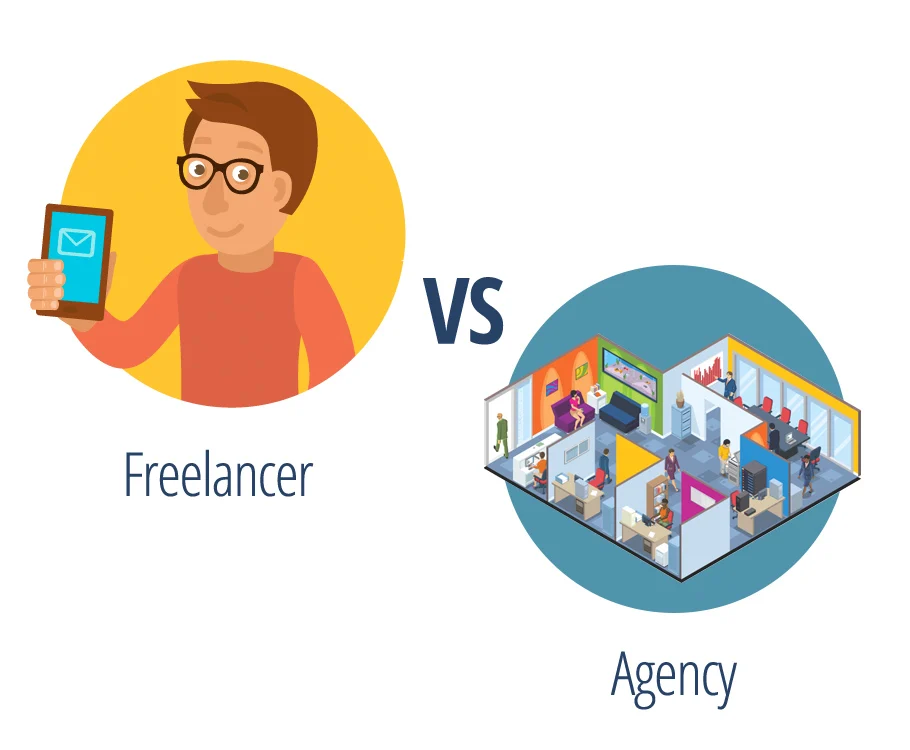
Agency vs. Freelancer: Who Should You Hire for Your Web Project?
10 June, 2025

Carlos Dusan
Table of Content
- Defining the Contenders: What’s the Real Difference?
- The Ultimate Showdown: Agency vs. Freelancer Head-to-Head Comparison
- When to Bet on a Freelancer for Your Web Project
- When a Web Agency is the Winning Choice
- Exploring Different Models: It's Not Always Black and White
- How to Vet Your Partner (No Matter Who You Choose)
- FAQ: Answering Your Lingering Questions
- Conclusion: It’s Not Agency vs. Freelancer, It’s About the Right Fit
Subscribe to Our Newsletter
Get the latest web development tips, SEO strategies, and industry insights delivered to your inbox.You are now subscribed to our newsletter. Thank you
You've got a game-changing idea for a website. The vision is clear, the potential is huge but you've hit your first major hurdle. Who do you trust to bring this digital dream to life? This single decision can make or break your project's success, timeline, and most importantly, your budget. It's the classic showdown in the web development world: the nimble, specialized freelancer versus the powerhouse, all-in-one agency.
Forget the biased opinions and confusing sales pitches. This guide is your impartial referee. We'll walk you through a head-to-head comparison, explore real-world scenarios, and give you a clear framework to decide whether a web design agency or a freelance web designer is the right champion for your web project.
Defining the Contenders: What’s the Real Difference?
Before we dive into the nitty-gritty, let's get a clear picture of who we're talking about. While both build websites, their approach, structure, and what they offer can be worlds apart.
The Freelancer: The Specialist Solo Act
Think of a freelancer as the special-ops of the web world. They are independent, self-employed professionals who are often masters of a specific craft. You're not hiring a jack-of-all-trades; you're hiring a specialist with deep knowledge in one or two key areas, like UI/UX design, front-end development, or WordPress customization.
Hiring a freelancer is like commissioning a master sculptor. You work directly with the artist, communicating your vision to create a specific, beautifully crafted piece. This direct line of communication is one of their biggest selling points.
The Web Agency: The Full-Service Powerhouse
A web development agency is a registered company with an in-house team of diverse experts who collaborate on projects. Hiring an agency is like hiring a general contractor to build your dream home. They manage the architects (designers), electricians (back-end developers), plumbers (integrations specialists), and painters (content creators) to deliver a complete, move-in-ready house.
You get a project manager, developers, designers, SEO specialists, and marketers all under one roof. A great example is a full-service digital agency like Search Boss, which provides a wide array of services from web development and UI/UX design to SEO and paid ad management.
The Ultimate Showdown: Agency vs. Freelancer Head-to-Head Comparison
Your choice will ultimately depend on your project's specific needs. A study found that 48% of people cited a website’s design as the number one factor in deciding a business's credibility, so this isn't a decision to take lightly. Let's break down the key differences.
| Factor | Freelancer (The Lone Wolf) | Agency (The Wolf Pack) |
| Expertise & Services | Deep knowledge in 1-2 niche areas. Perfect for specialized tasks. | A broad spectrum of skills. Offers comprehensive, end-to-end services from strategy to marketing. |
| Cost & Budget | Generally more affordable due to lower overhead. Ideal for tight budgets. | Higher investment. You're paying for a team, project management, and extensive resources. |
| Project Management | You are the project manager. Communication is direct but requires your active involvement. | A dedicated project manager handles everything. The process is structured but less direct. |
| Speed & Turnaround | Can be very fast for small, defined tasks. Can become a bottleneck on larger projects. | Can deploy multiple resources to accelerate large projects. May have more formal procedures that slow down small changes. |
| Scalability | Limited. One person can only do so much. Scaling up means finding and vetting more freelancers. | Highly scalable. The team can grow with your business needs, handling more complex tasks over time. |
| Accountability | Accountable to their personal reputation. Can be a single point of failure if they get sick or disappear. | Contractually obligated with a reputation to uphold. Team redundancy means the project continues even if one person is unavailable. |
| Long-Term Support | Availability can be inconsistent after the project ends. They may move on to other clients. | Often offer ongoing maintenance, support retainers, and marketing services to be a long-term partner. |
When to Bet on a Freelancer for Your Web Project
Hiring a freelance developer can be a brilliant move in the right situation. It's not just about saving money; it's about getting the right expert for a specific job.
You should hire a freelancer for a simple WordPress website or similar project if:
- Your Project is Small and Clearly Defined: You need a 5-page brochure site, a new landing page, a specific bug fixed, or a website redesign of a few key pages.
- Your Budget is Tight: This is the big one. Freelancers are almost always the more cost-effective option for straightforward tasks. A freelance web designer in the UK might charge £1,000 - £2,500 for a standard 5-page site whereas an agency might start at £3,000.
- You Have Time to Manage the Project: You're comfortable being the main point of contact, providing clear direction, and managing deadlines. You essentially become the project manager.
- You Need a Niche, Specialized Skill: You need an expert in a very specific technology, a particular design style, or a platform like WordPress. Marketplaces like Codeable and Guru specialize in connecting you with vetted WordPress experts.
Case Study: A local coffee shop wants an elegant website with their menu, hours, and location. Their needs are clear and their budget is modest. A freelance WordPress developer is the perfect fit, delivering a beautiful, functional site quickly and affordably.
When a Web Agency is the Winning Choice
Sometimes, a project's scope and ambition demand the power and structure of a full team. A web project agency or freelancer debate often ends here when complexity enters the picture.
You should hire a web agency if:
- Your Project is Large or Complex: You're building an e-commerce platform with thousands of products, a custom web application, or a site requiring complex integrations with other software.
- You Need a Full Suite of Services: Your project requires design, development, SEO, and a marketing strategy from day one. Top Web Development Companies like WebFX or a software development firm like Geniusee are built for this integrated approach, offering everything from initial strategy to post-launch marketing.
- You Need a Long-Term Partner: You see your website as an evolving business asset. You need ongoing maintenance, security updates, performance optimization, and strategic guidance to grow.
- You Prefer a Hands-Off Approach: You want a single point of contact (a project manager) to handle all the moving parts. This allows you to focus on running your business, not managing developers and designers.
Case Study: A fintech startup is launching a new SaaS product. They need a secure marketing website, a complex user portal with payment integration, and an aggressive SEO campaign to attract their first customers. The scope is too large and diverse for one person. A web design agency is the clear winner, providing the strategic oversight, diverse skill set, and scalability the startup needs to launch successfully.
Exploring Different Models: It's Not Always Black and White
The choice isn't always a stark one between a lone freelancer and a massive agency. The modern web development landscape is full of interesting and effective hybrid models.
- The Hybrid Approach: Many businesses find success by hiring an agency for the heavy lifting—the initial strategy, design, and foundational build. Once the site is launched, they retain a trusted freelancer for smaller, ongoing tasks like content updates, minor tweaks, and maintenance. This gives you the best of both worlds: the strategic power of an agency and the cost-effective flexibility of a freelancer.
- The "Agency of One": Some highly experienced freelancers operate like a small agency. They act as the primary consultant and project lead, bringing in other trusted freelancers from their network to collaborate on specific parts of a larger project.
- Unique Service Models: Companies are constantly innovating the service model. For example, Launchpad offers a unique, structured process to deliver free websites for small businesses, completely blurring the lines and providing a valuable entry point for those with minimal budgets.
How to Vet Your Partner (No Matter Who You Choose)
Whether you're leaning toward an agency or a freelancer, a thorough vetting process is non-negotiable. Your website's success depends on it. According to Stanford research, 75% of users judge a company's credibility based on its website's design. Here’s how to make sure you hire a winner.
- Dig Through Their Portfolio: Don't just look at the pretty pictures. Visit the live websites they've built. Do they load quickly? Are they easy to navigate? Do the projects align with your goals and industry? A portfolio is the best evidence of their capabilities.
- Hunt for Social Proof: What are past clients saying? Look for reviews and testimonials on platforms like Google and Clutch. A reputable agency or freelancer should be able to provide you with client references you can speak to directly.
- The "Chemistry Check" Interview: This isn't just about skill; it's about partnership. Ask about their communication process. How do they handle feedback and revisions? What happens when something goes wrong? You want a partner who is transparent, responsive, and easy to work with.
- Demand a Crystal-Clear Proposal: A vague proposal is a massive red flag. The document should explicitly detail the scope of work, all deliverables, a clear timeline with milestones, and the total cost. There should be no ambiguity about what you're paying for and when you'll get it.
FAQ: Answering Your Lingering Questions
Is an agency always more expensive than a freelancer?
Generally, yes. Agencies have higher overhead costs (salaries, office space, project managers), which are reflected in their pricing. However, a complex web project requiring multiple specialized freelancers could potentially end up costing as much as, or even more than, a small agency's project fee. The cost difference between a US freelance developer and an agency can be significant. A freelancer might charge $50–$150 per hour, while an agency could charge $100–$200+ per hour. It's about the total value and scope, not just the hourly rate.
Who owns the website and the code after the project is done?
You should. This must be clearly stated in your contract. Upon final payment, all work—including design files, code, and content—should become your intellectual property. If a provider is hesitant to agree to this, consider it a major red flag.
What are the red flags to watch out for when hiring?
Be wary of providers who:
- Offer a price that seems too good to be true.
- Have a weak or non-existent portfolio.
- Communicate poorly or are unresponsive.
- Demand full payment upfront.
- Cannot provide client references.
Can I hire a freelancer from a marketplace like Upwork?
Absolutely. Platforms like Upwork offer a vast pool of talent. However, the quality can vary wildly. You'll need to invest significant time in vetting candidates, reviewing their work history, and checking their ratings to find a reliable professional.
Conclusion: It’s Not Agency vs. Freelancer, It’s About the Right Fit
The debate of agency vs. freelancer isn't about finding a universal "better" option. The perfect choice depends entirely on your project's unique DNA: its complexity, your budget, your timeline, and how involved you want to be.
If you have a straightforward, well-defined project and a tight budget, a skilled freelancer is likely your hero. If you're launching a complex, multi-faceted platform and need a long-term strategic partner to handle everything, a web agency is your champion.
You're now armed with the knowledge to look past the labels. You can confidently analyze your project and choose a partner—be it a nimble freelancer or a powerhouse agency—that will set your web project up for undeniable success.
What has your experience been? Have you had a great success story with an agency or a freelancer? Share your thoughts in the comments below!
Still feeling stuck? A web project is a major investment. If you're leaning towards a comprehensive, results-driven approach, contact Search Boss for a free, no-obligation quote to see how our team can bring your vision to life.